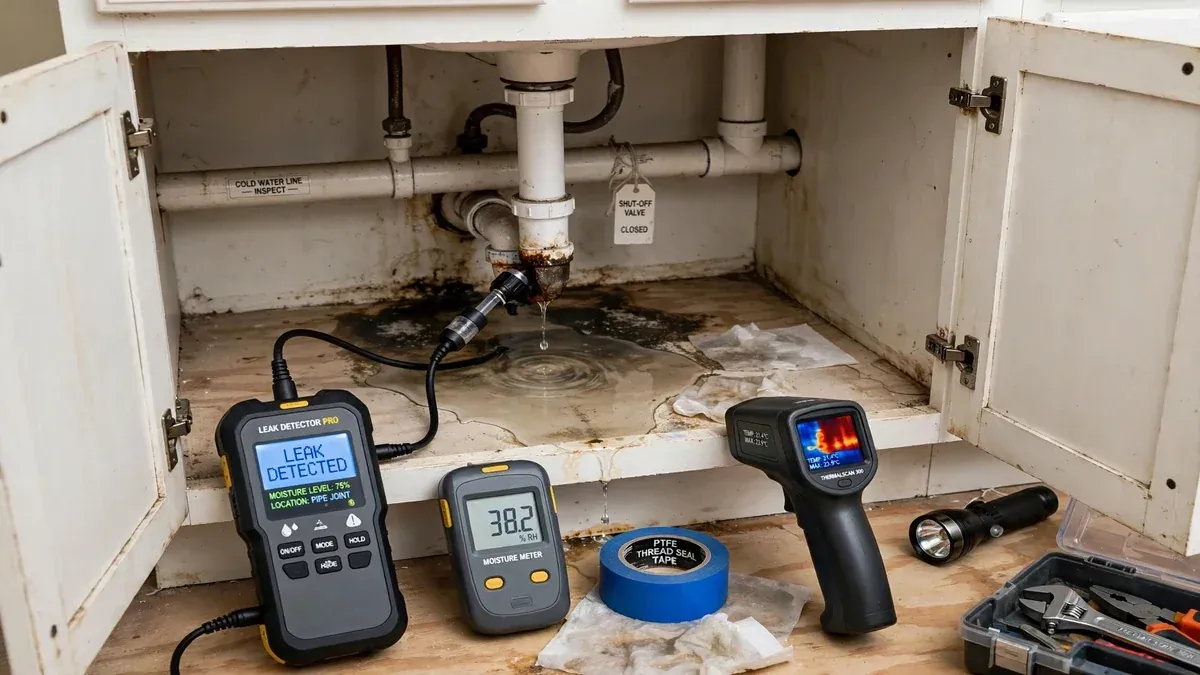
What an infrared camera does and does not show
An infrared camera, also called a thermal imager, shows surface temperature as a color picture. It does not see water, and it does not see through walls. It shows places where a surface is warmer or cooler than the area around it.
A leak can cause that kind of difference. Wet material often runs cooler than dry material because water evaporates. A hot water line leaking into a slab can warm one patch of floor. The camera spots the temperature pattern, and a person has to work out whether water caused it.
Where thermal imaging helps
Good uses for an infrared camera
- Scanning a ceiling or wall to find where a stain is widest before cutting a small access hole.
- Tracing a hot water line leak under a floor, where the warm patch can show on the surface.
- Checking a wall around a shower, tub or washer box for cool, wet-looking zones.
- Finding cool spots along an outside wall that suggest moisture got in.
- Narrowing a search so listening gear starts in the right room.
In each case, the camera shrinks the search area. It does not replace the next step.
Where it falls short
| Situation | What goes wrong | What works better |
|---|---|---|
| Cold water line under a slab. | The pipe temperature may match the floor, so little shows. | Listening gear and a pressure test. |
| Deep leak in a thick slab or under tile. | Concrete spreads and hides heat differences. | Acoustic tools and hot line checks. |
| Humid air and A/C condensation. | Condensation makes cool spots that look like leaks. | Moisture meter readings to confirm. |
| Same temperature as the surroundings. | No difference means no image. | Comparison readings at different times of day. |
| Leak inside a drain line. | Waste water is not under pressure and may not change the surface. | A drain camera. See sewer camera inspection. |
Southwest Florida adds its own wrinkle. Warm, humid air and cold air conditioning ducts produce plenty of cool patches on ceilings and walls. A thermal image taken in an A/C-cooled room will show many of them. A plumber who knows the area reads those patterns with care.
Warm patch on the floor or a stain on the ceiling? Call and describe it.
Call (239) 522-0887How a leak search typically runs
- 1Talk through the symptomsDispatch asks where the stain, sound or warm spot is and how long it has been there.
- 2Check the meterWith every fixture off, a moving meter tells the plumber whether water is leaving the system.
- 3Scan with the cameraThe plumber looks at ceilings, walls and floors for temperature differences.
- 4Confirm with other toolsA moisture meter, listening gear or a pressure test checks whether a suspicious area is actually wet.
- 5Mark the spot and explainYou get the findings, the evidence behind them and the repair options. Opening a wall or slab is the last step.
Slab leaks and the warm floor question
Many Estero homes are built on a concrete slab, with supply lines running under or in it. A hot water line that leaks can warm a spot on the floor, and bare feet often notice it before any camera does. Thermal imaging can show that patch clearly on tile or laminate.
It is still not the end of the investigation. A warm spot could also come from a hot water line close to the surface that is not leaking. Our page on slab leak repair explains the full process, including how the leak is confirmed.
What to do while you wait
Check the meter
Turn everything off and see whether the leak indicator moves.
Shut off the water if it is active
Close the main valve if water is spreading or ceiling drywall is sagging.
Protect the electrics
If a ceiling is dripping near lights, fans or outlets, shut off the breaker for that area and keep away from the wet zone.
Move belongings
Lift rugs and furniture so wet floors can dry and the plumber can reach the area.
If a ceiling bulges with water, stay out from under it and keep people away. The weight can bring the drywall down without warning, so call right away.
What affects the cost
What changes the price of a hidden leak search
- Size of the area
- A single room is faster than a whole house.
- Types of tools needed
- A thermal scan alone is shorter. Adding listening or pressure tests adds time.
- Hot or cold line
- Hot lines show on thermal imaging more often than cold lines do.
- Access
- Finished floors and tight crawl spaces take longer.
- Repair needed
- Finding a leak and fixing it are separate jobs.
We give a clear price before work starts, after we know what the search involves.
Want your real number? Call (239) 522-0887.
When to call a plumber
Call if your meter moves with everything off, a stain keeps growing, or a floor feels warm in one spot. Waiting lets damage spread. If a pipe has already burst, shut the main and see burst pipe repair.
We work in the Village of Estero and neighboring areas, including San Carlos Park. Phone dispatch, describe what you see, and a plumber will plan the tests that fit.
No plumbing code sets a standard for thermal imaging, so ask what the technician will use to confirm a cold spot, such as a moisture meter, before anyone opens a wall.
Seasonal homes in Bonita Springs are a good case for scanning, since a leak can run unnoticed while nobody is home.
Infrared leak detection questions
No. It reads surface temperature. Water inside a wall may cool the surface, but other things do too. A moisture meter confirms it.
Sometimes, mostly hot water leaks that warm the floor. It can miss cold water leaks. Listening gear and pressure tests do much of the work.
No. It is a screening tool. A plumber needs a second kind of evidence before opening a wall or floor.
Air conditioning, sunlight, insulation gaps and condensation all change surface temperatures. Humid Southwest Florida makes this common.
You can scan for clues, but you may misread them. Treat anything unusual as a reason to call, not as a diagnosis.
Not reliably. Drains need a drain camera inside the pipe. Ask about sewer camera inspection if you smell sewage.
Where you see a stain, warm spot or sound, how long it has been there, what the meter does and whether water is active right now.
Still deciding? Call (239) 522-0887 any hour and talk it through.