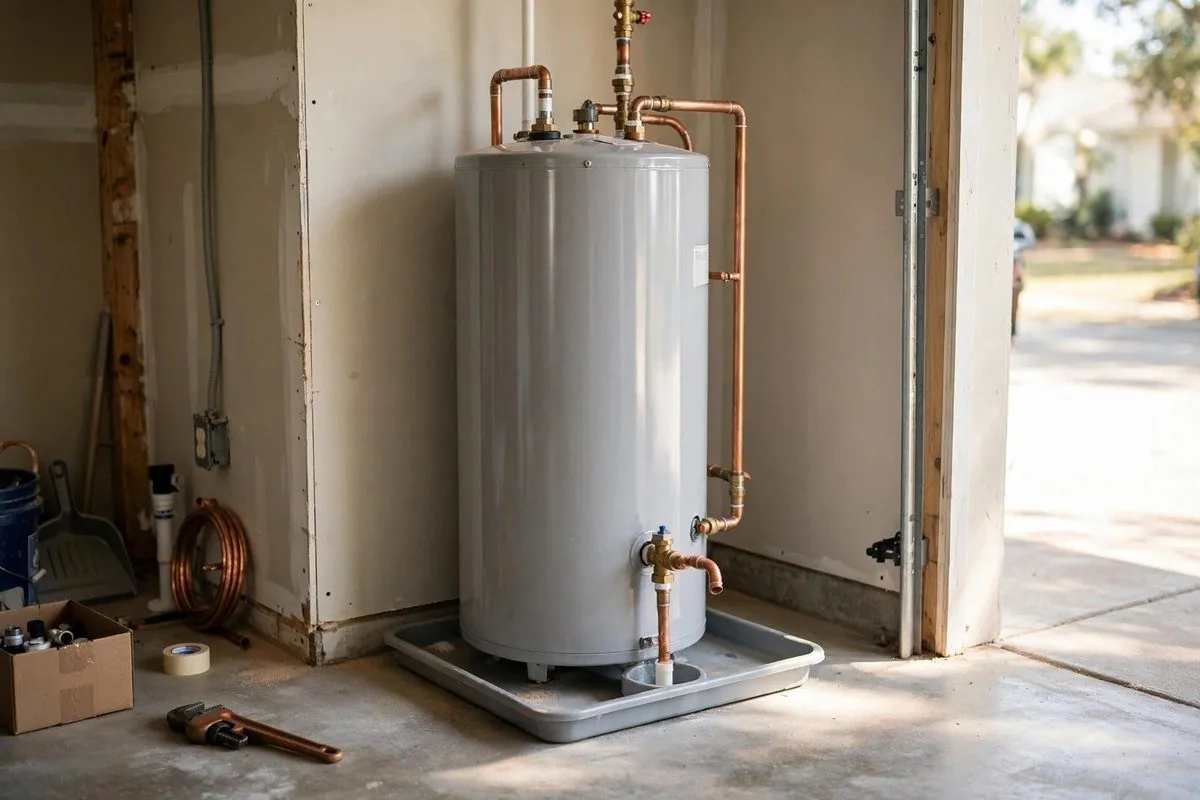
Can a homeowner do it? The direct answer
Some homeowners do swap an electric tank heater themselves, and some are comfortable with the basics. A gas unit is a different matter, because a bad gas connection or vent can leak fuel or carbon monoxide into the house. We recommend a licensed plumber for gas units and for any change in fuel, location or venting.
Before you buy anything, ask the Village of Estero Community Development department what applies to your address. Permit rules vary, and Florida law and local rules decide who may do the work, not us.
What the job actually involves
- 1Shut off supply and energyClose the cold water valve, then turn off the breaker or the gas valve to the heater.
- 2Drain the old tankAttach a hose to the drain valve and open a hot tap upstairs so it can empty. A full tank is heavy and hot.
- 3Disconnect and removeUnhook the water lines, the gas or electrical connection, the vent and the relief valve pipe. Carry the old tank out.
- 4Set the new unitPlace it level on a pan or stand as required, with the right clearances around it.
- 5Reconnect lines and fittingsUse new flex connectors, a proper relief valve and drain line, and tight, tested joints.
- 6Fill, test and light or power upFill the tank, bleed the air, check every joint for leaks, then restore power or gas and check operation.
Each step has places where a small mistake becomes a flood or a safety problem. The relief valve and its drain line, for example, protect against pressure and heat building up in the tank. Skipping or capping them is dangerous.
Where do-it-yourself swaps go wrong
Common first-time mistakes
- Reusing old flexible connectors or shutoff valves that were already corroded.
- Leaving air in the system, which makes the unit sputter or run on a dry element.
- Energizing an electric heater before the tank is full, which burns out the elements.
- Poor venting on a gas unit, which can pull exhaust back into the home.
- Skipping the relief valve drain line, or running it somewhere unsafe.
- Missing the permit, then finding out when selling or filing an insurance claim.
Permits, code and the Village of Estero
The Village of Estero Community Development department takes building and trade permit applications, and the Village website has a Trade Permit application. Whether swapping a water heater needs one at your address is a question for them, since rules vary.
Permits applied for after December 31, 2023 follow the Florida Building Code, Plumbing, 8th Edition. If you live in an unincorporated area such as San Carlos Park, ask Lee County instead. An unpermitted install can raise questions with an insurer or a buyer later, so ask first and keep the paperwork.
DIY or hire: how to decide
| Your situation | DIY realistic? | Why |
|---|---|---|
| Electric tank, same size, same spot, accessible shutoffs | Possibly | Still needs correct connectors, relief valve and a permit check. |
| Gas tank, same spot | Leave to a licensed plumber | Gas connections and venting are safety critical. |
| Moving the heater or changing fuel type | No | New gas, electrical or venting work that likely needs a permit. |
| Switching to tankless | No | Sizing, gas line and vent changes. See tankless service. |
| Tight attic, closet or second-floor install | Rarely | Weight, access and leak risk make mistakes costly. |
| Heater is leaking from the tank body | Replacement needed | The tank cannot be repaired, and timing matters. |
What you save and what you risk
What a DIY swap really involves cost-wise
- The unit itself
- You pay for the heater either way, and a plumber can often source one that fits your closet.
- Parts people forget
- Connectors, valves, a drain pan, venting pieces and a proper relief valve add up.
- Tools and hauling
- Hoses, wrenches, a dolly and a way to dispose of the old tank.
- Mistake risk
- One bad joint can soak a wall or floor, and water damage costs more than the labor you saved.
- Permit and inspection
- If a permit applies, it applies whether you or a plumber does the work.
A clear price from a licensed plumber before work starts is the fair comparison, not parts alone.
Want your real number? Call (239) 522-0887.
Honest limit: we cannot tell from the phone whether your particular closet, vent or gas line is a simple swap. A short look on site decides it.
When to stop and call right now
Stop the DIY if
- You smell gas or see a pilot or burner flame that looks wrong.
- The tank is leaking and you cannot shut off water at the unit.
- The vent pipe is corroded, loose or does not slope the way the old one did.
- Water is dripping near the electrical connection or the panel.
- You are unsure of the voltage, the wire size or the breaker rating.
Standing water or no hot water now? Call and we will plan the swap with you.
Call (239) 522-0887Hiring a licensed plumber in Estero
Florida plumbing contractors hold a Certified Plumbing Contractor licence through the Department of Business and Professional Regulation. Ask any plumber for their licence number and look it up at myfloridalicense.com under Verify a Licensee. Check that the status is current and active.
If you want the work done properly in one visit, see water heater installation. We serve the Village of Estero and Bonita Springs, and dispatch answers around the clock.
Water heater replacement follows the Florida Building Code, Plumbing, 8th Edition and the maker's installation instructions. Permit rules vary, so ask the Village of Estero Community Development department before you buy.
If you live in San Carlos Park, ask Lee County, not the Village, whether a water heater swap needs a permit.
Water heater DIY questions
Rules on homeowner work and permits depend on the type of job and the local authority. Ask the Village of Estero Community Development department, or Lee County if you are unincorporated.
Generally, yes, because there is no gas line or exhaust venting. It still involves water connections, a relief valve and high-amperage wiring, so shut off the breaker first.
A first-time swap often runs longer than a professional one, especially with draining and fitting trouble. Plan on hours, not minutes, and have a backup place to wash up.
It can come up when you sell, file an insurance claim or have the home inspected. Ask the Village first, because we cannot state their rules for you.
We do not recommend it. Old connectors and shutoffs are common leak points, so replace them when the heater is out.
Sediment or air in the tank is a common cause. If it persists after the tank is full and bled, call a plumber to inspect it.
We recommend it. Gas connections and venting protect your home from fire and carbon monoxide, so a licensed plumber is the safer path.
Still deciding? Call (239) 522-0887 any hour and talk it through.